What can we help you with?

Get legitimate documentation and personalized support in minutes.
╳

The State of ESA Housing Rights: What Happens When a Landlord Says "No"

September 23, 2026
Updated On by
Get Your ESA Letter
Pettable surveyed 300+ renters denied ESA housing accommodations. See what the data reveals about the housing, financial, and mental health fallout.
Fact checked

The State of ESA Housing Rights: What Happens When a Landlord Says "No"

Pettable's ESA denial rate is under 2%, but little is known about what happens to renters who do get turned down. This article shares findings from Pettable's survey of 300+ members denied an ESA accommodation in summer 2026 — one of the largest known studies of denial outcomes. It covers state-level denial trends, the housing and financial fallout, and a significant mental health toll, including higher rates of depression and self-harm ideation versus Pettable's broader client base, plus the steps Pettable is taking in response.

Author
Alicia Ramella
-
at
Ā·
September 24, 2026
September 23, 2026
Ā·
8 minute read
Updated By
Ā·
Expert Reviewed By:
-
at
Ā·
September 23, 2026
September 23, 2026
Ā·
8 minute read
Updated By
Ā·
Pettable surveyed 300+ renters denied ESA housing accommodations. See what the data reveals about the housing, financial, and mental health fallout.

Landlord ESAĀ Letter Denials: The Problem No One is Studying

There is plenty of information about whether an emotional support animal (ESA) assists people with mental health disorders. But what isn't studied enough is what happens when a landlord denies a person's ESA letter. What is the aftermath that someone has to go through once they receive an ESA denial from their landlord?

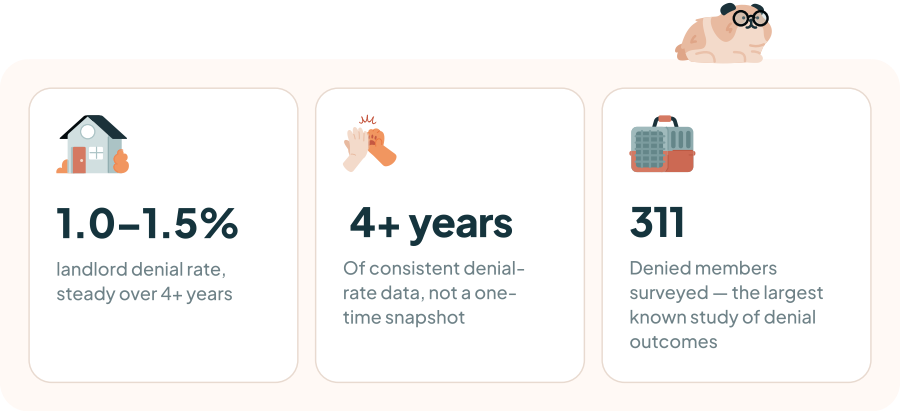
Pettable has facilitated thousands of ESA evaluations, and historically under 2% of our customers experience a landlord denial. This rate has been steady over the past four years.

ESA research focuses heavily on whether ESAs work for people, but we want to look at what happens when a landlord denies an ESA letter. As a platform that connects individuals with licensed therapists for ESA evaluations, we have a unique vantage point. We surveyed over 300 members who were denied emotional support animals in the summer of 2026 after their landlords refused to accept their documentation.

Our study is the largest known study of denial outcomes. In this article we will take a deep dive into the impacts that these denials have on our customers.
What the Data Shows — ESA Letter Denial Rates and Trends

Over the past 4+ years, Pettable's baseline denial rate has consistently been under 2% of purchases.

Our clinicians follow all state-specific laws and regulations, ensuring that our ESA letters are legal and meet any "30-day" rules or other state-specific requirements.

Various states have created their own laws and standards for landlords to handle ESA accommodation requests. Certain states require at least a 30-day minimum patient-provider relationship with a therapist before the ESA letter can be written.
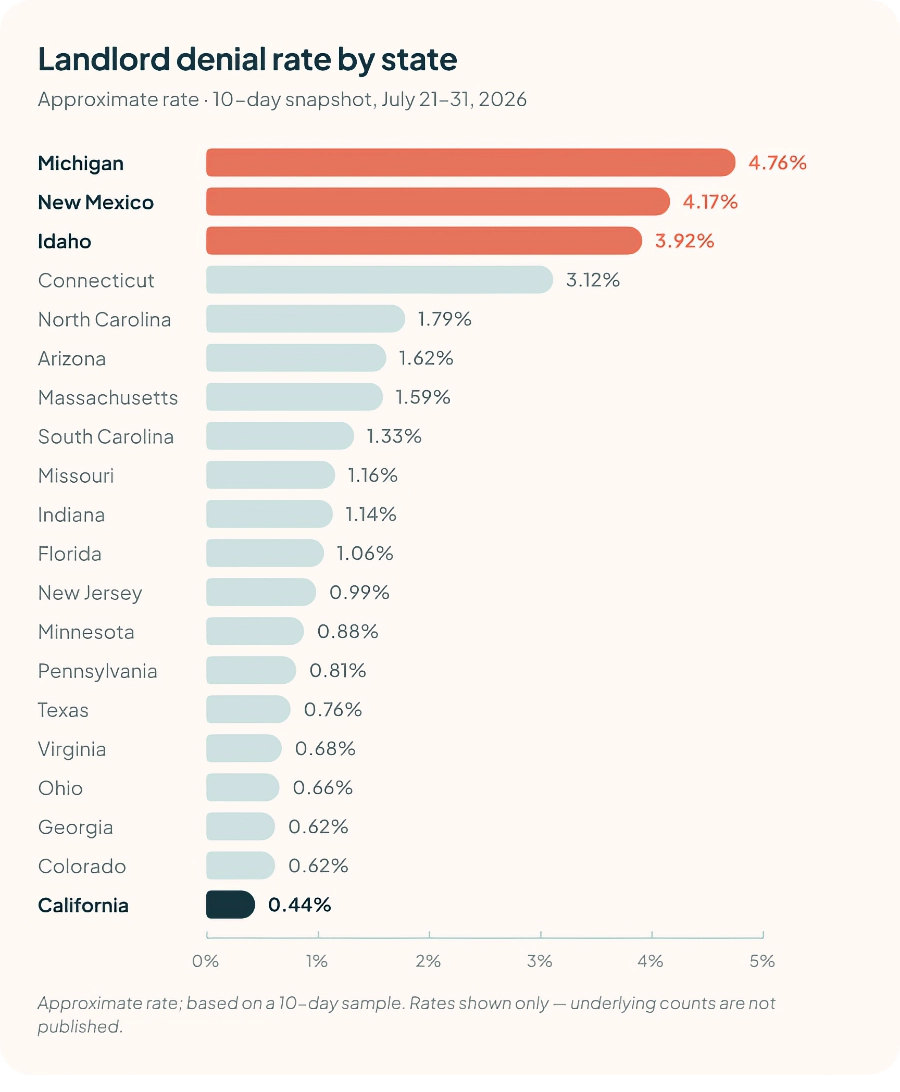
States in this category include California, Montana, Louisiana, Arkansas, and Iowa. One may think renters in these states would see higher denial rates because of this rule, but denials in 30-day states largely due to ESA letter fraud or invalid letters, not people who see a licensed provider multiple times through compliant platforms like Pettable..

Florida and New York have stricter verification processes, which can lead to technical denials if paperwork is incomplete or clinicians' licensing numbers are missing.

Around 20 states have ESA anti-fraud laws and regulations that penalize fake documentation or misrepresenting pets as assistance animals. This seems to lead to more denials and more legal scrutiny.

Some states have their own local fair housing offices that process complaints independently. This seems to reduce landlord denials by closing gaps in federal Fair Housing Act (FHA) enforcement and enforcing local laws to protect ESA owners.

What Happens After a Denial — The Human Impact

ESA landlord denials are more than just numbers. They affect real people with mental health issues who are now forced to pivot their housing plans.Ā 

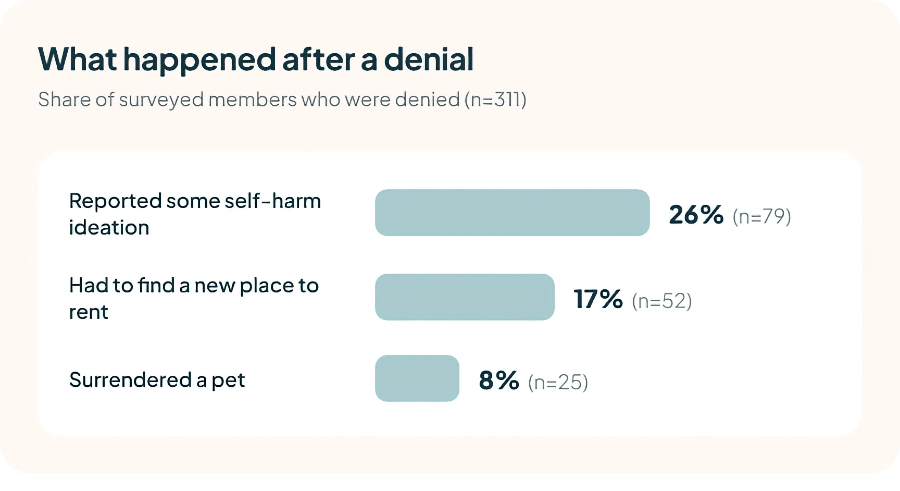
Landlord denials carry significant family, housing, and safety impacts: Of the surveyed group (n=311), 8% of users surrendered a pet (n=25), and 17% had to find a new place to rent (n=52). Worse yet, 26% (n=79) reported having some thoughts of self-harm.

ESA denials can worsen mental health issues, but awareness and advocacy can lead to better protections and support for affected individuals.
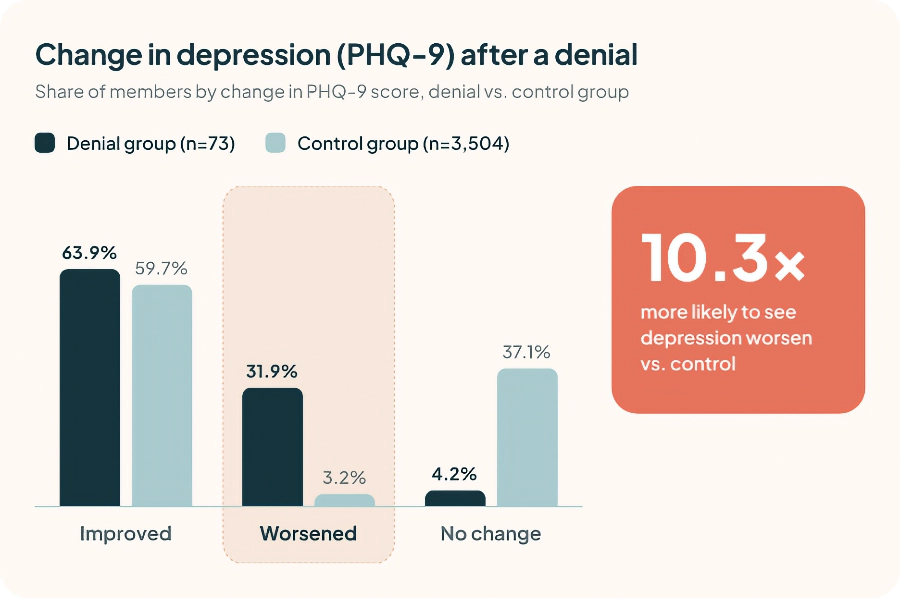
The mental health of ESA owners is also at stake. A landlord denial makes members far more likely to get worse: Compared to our control Pettable group (n=3,504), the test (n=73) group was 10.3x more likely to see depression worsen (31.9% of denial group vs. 3.2% of control group) and 39x more likely to see sentiment worsen (63.4% of test group vs. 1.7% of control group).

We also saw a 26% overall self-harm ideation, rising to 40–50% in the worst-outcome groups. This is another reason why it is so important to protect housing access for people with disabilities and ESAs.
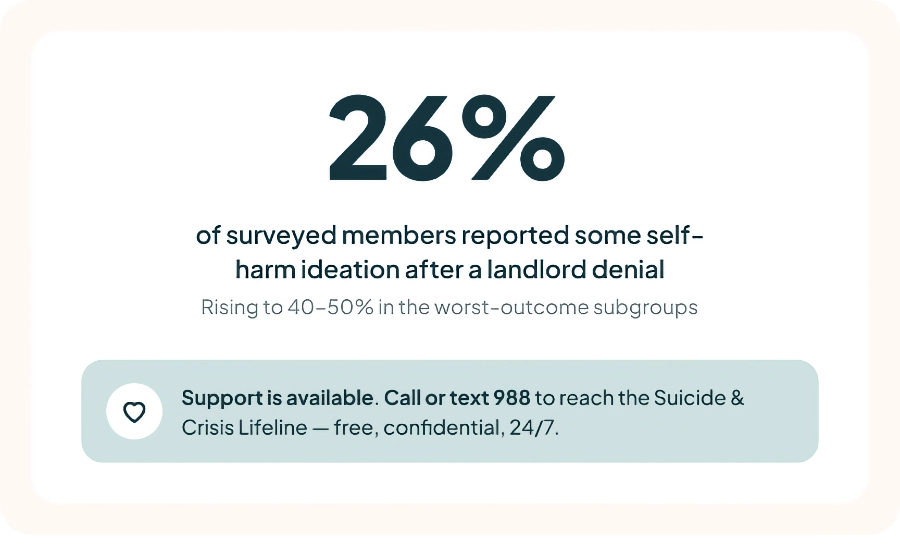
Self-harm ideation is a serious matter. If at any time you have any of these thoughts, or if you need emotional support or just need someone to talk to, please call the 988 Suicide and Crisis Hotline.

Sometimes, ESA denials don't just affect where someone lives, they ripple into finances and emotional well-being at the same time. When a landlord denies an ESA request, members are often left weighing an impossible tradeoff: keep paying fees they can't really afford, or start over somewhere new.

"I was so upset. I struggled financially and emotionally for over 12 months and eventually had to leave that apartment."

PHQ‑9: 27 Stayed, paid pet rent

Initially, they stayed and paid the pet rent fee, doing what it took to keep their ESA close. But covering that extra cost every month for over a year eventually became unsustainable, and they made the difficult decision to move out and find a new place to live with their ESA.

In some cases, an ESA denial doesn't just affect one person, it puts an entire household's stability at risk. That's especially true for members who are expecting, where the stress of a denial collides with the pressure of preparing a home for a new baby.

"I was heavily pregnant and absolutely devastated knowing that we may not have a place to live once our child came."

PHQ‑9: 18 Had to find a new place

This member was forced to find a new place to live while she was pregnant, on top of everything else that comes with preparing for a child. She described being consumed by the worry that she and her baby could end up without stable housing by the time the baby arrived.

Some ESA denials have led to consequences far more severe than an extra fee: for a handful of members, it meant losing stable housing altogether. These are the stories that make clear how high the stakes of a denial can be, especially for families with children.

"I was temporarily homeless with my 3 children."

PHQ‑9: 6 Had to find a new place

This member and her three children were temporarily without a home following the denial. She was ultimately able to find a new place to live, but not before going through a period of real instability for her whole family.

ESA denials can lead to high financial costs, and for some members those costs go far beyond a monthly pet-rent fee. When a denial forces a sudden move, the price tag can climb quickly (hotel stays, storage, moving costs) all before a new lease is even signed.

"I was forced to live in a studio hotel room with my 3 kids and 3 ESAs… it cost an additional $20,000 until I found a house 3 months later."

PHQ‑9: 20 Other

In this case, the member and her three children lived in a studio hotel room with all three of their ESAs for months, adding up to an additional $20,000 in costs before she finally found a house that worked for her family.

Sometimes an ESA denial forces a decision no member should have to make: surrender the very animal that's part of their treatment. The toll of that choice can be significant, especially when the ESA was providing real, daily support.

"I became severely depressed and went back into weekly therapy. It affected my relationship with my spouse and family. I had to take time off work due to poor mental health and anxiety."

PHQ‑9: 19 Had to surrender pet

After surrendering her pet, this member fell into an intense mental health spiral. She went back into weekly therapy, took time off work, and said the strain reached into her relationship with her spouse and family as she worked to manage her depression and anxiety.

Another member endured continuing feelings of hopelessness following an ESA denial, and unlike some of the other stories here, hers didn't resolve with a move or a new home. She's still living with the aftermath.

"I fell into a deep depression and an even more financial burden due to the denial. I still am trying to keep up with it to this day and I feel hopeless that it's going nowhere."

PHQ‑9: 22 Stayed, paid pet rent

They stayed after the denial and continued to pay the pet rent fee every month. Nearly a year later, she says she's still trying to catch up financially, and the depression that followed the denial hasn't lifted.

Another member was forced to hide their pet altogether rather than risk losing it or falling further behind on pet rent. For someone managing generalized anxiety disorder, that kind of secrecy adds a whole new layer of stress to an already difficult situation.

"I had to secretly have my pet and not pay pet rent. I have GAD, but could not afford to pay pet rent when my ESA was denied."

PHQ‑9: 10 Other

She's continued keeping her pet under the radar, going without paying pet rent because the cost simply wasn't something she could absorb on top of managing her anxiety.

What Pettable is Doing About ESA Letter Denials

Pettable is proactively working to ensure our customers have the best chance of getting letters that work. To accomplish this, we are implementing provider and clinical quality initiatives such as:

  • Utilizing monthly provider letter audits to maintain our best-in-class, high-quality ESA letter documentation.
  • Implementing a network management function to ensure that our missed call, late call, and late letter or form rates stay as low as possible so that our customers have what they need.

We also offer an ESA landlord toolkit that includes scripts for talking to your landlord and tenant education.

We will continue PHQ-9 outcomes measurements as part of our standard care model.

What's Next — A Call for More Research

These are early findings from an under-studied population, and while it is an exciting starting point, more work is needed.Ā 

Our next phase is intake-to-survey PHQ-9 benchmarking: comparing where members started clinically with where they are a year after denial, alongside members whose letters were accepted. That will turn today's snapshot into a measured before-and-after.

We'd welcome collaboration with researchers, housing advocacy organizations, and policymakers interested in understanding what happens after ESAs are denied.Ā 

To our knowledge, no other study has tracked the mental health trajectory of individuals denied ESA accommodations. We hope this is the first of many.

Meet the author:
Alicia Ramella
-
at

Alicia Ramella is a freelance writer specializing in mental health and wellness. She has been writing professionally for over three years in this space. Her work has been featured on reputable sites like WEBMD.com and many other health and wellness websites.

Alicia is also a life coach, a podcaster, and a nutrition nut with a background in psychology. She plays with her two children in her free time and enjoys music, gardening, and nature.

See Archive
housing-rights